Nepal is not just a country — for devout Hindus, it is the holiest land outside India. Home to Lord Shiva's earthly throne at Pashupatinath, Lord Vishnu's Himalayan sanctuary at Muktinath, Goddess Sita's birthplace at Janakpur, and the sacred birthplace of the Buddha at Lumbini, Nepal holds a spiritual significance that draws millions of Indian pilgrims every year. This guide lists the finest pilgrimage sites in Nepal — what makes each unique, why it matters to Indian devotees, the best time to visit, and how to reach there from Gorakhpur.
All Pilgrimage Sites at a Glance
- 01Pashupatinath Temple — Kathmandu
- 02Muktinath Temple — Mustang
- 03Janaki Mandir — Janakpur
- 04Lumbini — Birthplace of Buddha
- 05Manakamana Temple — Gorkha
- 06Gosaikunda Lake — Langtang
- 07Swayambhunath — Kathmandu
- 08Boudhanath Stupa — Kathmandu
- 09Halesi Mahadev — Khotang
- 10Devghat Dham — Chitwan
The Best Pilgrimage Sites in Nepal
Pashupatinath Temple
Pashupatinath Temple is the single most sacred Hindu shrine in Nepal and one of the most revered Shiva temples on Earth. "Pashupati" means Lord of All Living Beings — Shiva in his compassionate, protective form as the guardian of the universe. The main four-faced silver Shiva lingam inside the sanctum represents the four cardinal directions and the eternal nature of Shiva. The temple complex sits on the banks of the sacred Bagmati River — considered by Hindus to be as purifying as the Ganges — and spans a vast area containing hundreds of smaller shrines, dharamsalas, and cremation ghats (Aryaghat).
For Indian pilgrims, Pashupatinath carries the merit of a Jyotirlinga darshan. Hindu devotees — and only Hindus — are permitted inside the main sanctum. The evening aarti at Pashupatinath, performed at the river's edge as lamps are lit and conches blown, is among the most moving religious ceremonies you will witness anywhere. During Maha Shivaratri (February/March), millions of devotees converge on the temple — including hundreds of thousands of Naga Babas and sadhus from all over India and Nepal — making it one of the most extraordinary religious gatherings in Asia.
Muktinath Temple
Perched at 3,710 metres in the Mustang Himalayas, Muktinath is one of the holiest Vishnu temples in existence — one of the 108 Divya Desams revered in the Vaishnava tradition. "Muktinath" means Lord of Liberation: devout Hindus believe that darshan and a ritual bath under the 108 sacred water spouts (Muktidhara) here grants moksha — liberation from the cycle of birth, death, and rebirth. Both Hindus and Tibetan Buddhists (who call it Chumig Gyatsa, "Hundred Waters") regard this site as supremely sacred.
What makes Muktinath unique is its extraordinary combination of three sacred natural phenomena: the 108 water spouts, the eternal Jwala Mai flame (natural gas burning beside flowing water and earth — representing Agni, Jal, and Prithvi simultaneously), and the presence of sacred Shaligram stones — ammonite fossils found in the nearby Kali Gandaki riverbed that are considered to be the most sacred manifestations of Lord Vishnu on Earth. Pilgrims carry Shaligram stones home as the holiest of all prasad. The dramatic mountain landscape adds to the transcendent atmosphere.
Janaki Mandir, Janakpur
Janakpur is the legendary city of Raja Janak and the birthplace of Goddess Sita — the divine mother, the ideal of womanhood, the consort of Lord Rama. For devotees from Uttar Pradesh, Bihar, and neighbouring states — where the Ramayana tradition saturates daily life — Janakpur is deeply emotional territory. The Janaki Mandir (also called Naulakha Temple), built in 1911, is a magnificent white marble palace-style structure with Mughal-Rajput architecture, 60 rooms, and 72 ornate spires. Inside, the idol of Goddess Sita is enthroned with Lord Ram, Lakshman, and Hanuman in a scene of divine family bliss.
Around the temple, the sacred ponds of Janakpur — Dhanush Sagar, Ganga Sagar, Ram Sagar, and the Ratna Sagar — are sites where pilgrims take ritual baths. The Vivah Mandap, where the divine wedding of Ram and Sita was celebrated, is another profoundly moving place. The city's grandest moment comes during Vivah Panchami (November/December), when a spectacular procession re-enacts the wedding with thousands of devotees, elephants, and traditional musicians. Ram Navami and Diwali are also celebrated with great fervor.
Lumbini — Sacred Garden of the Buddha
Lumbini holds one of the highest places in the world's spiritual geography — it is the confirmed birthplace of Siddhartha Gautama (563 BCE), who became Gautama Buddha and founded Buddhism. For Buddhist pilgrims from India, Sri Lanka, Thailand, Japan, China, and the entire Buddhist world, Lumbini is what Mecca is to Muslims or Jerusalem to Christians. Even for Hindu pilgrims, Lumbini is significant: Hinduism recognises the Buddha as the ninth avatar of Lord Vishnu, and the site carries deep spiritual resonance across traditions.
The Mayadevi Temple marks the exact spot of the Buddha's birth, with a sacred nativity stone inside. The Ashoka Pillar, erected by the great Mauryan Emperor Ashoka in 249 BCE, stands inscribed in Brahmi script declaring the birth of the Enlightened One. The surrounding Lumbini Development Zone is a peaceful, carefully planned sacred garden containing over 30 monasteries built by Buddhist nations — Japan, China, South Korea, Myanmar, Thailand, Sri Lanka, Germany — each in its own national architectural style. Walking through these monasteries at dusk, with the sounds of chanting drifting across the gardens, is profoundly peaceful.
Manakamana Temple
Manakamana Temple — whose name literally means "wish-fulfilling" (Mana = Heart/Wish, Kamana = Desire/Fulfillment) — is one of Nepal's most beloved and visited temples. Perched at 1,302 metres on a hilltop in Gorkha district, it is dedicated to Goddess Bhagwati (a form of Durga/Parvati) and is believed to grant the heartfelt wishes of sincere devotees who make the pilgrimage. The goddess has been worshipped here since the 17th century, and the temple's location commands views of the Annapurna and Himalchuli mountain ranges.
What makes Manakamana especially popular with Indian pilgrims is the famous cable car — the Manakamana Darshan Ropeway — one of the first cable cars in Nepal, which carries devotees in gondolas up from Kurintar on the Prithvi Highway to the temple hilltop in a scenic 10-minute ride. The combination of a manageable journey, a powerful goddess, beautiful mountain scenery, and strong miraculous traditions makes Manakamana a must-visit for families and pilgrims travelling between Kathmandu and Pokhara.
Gosaikunda Lake
Gosaikunda is a sacred alpine lake at 4,380 metres in the Langtang region north of Kathmandu, one of the holiest sites in Nepal — a Himalayan tirtha (sacred pilgrimage ford) of great antiquity. According to Hindu scripture, Lord Shiva created Gosaikunda by striking the mountain with his trident (Trishul) to get water after swallowing the poison Halahala during the churning of the cosmic ocean (Samudra Manthan). The lake is considered to be directly connected underground to the Kumbheshwar Tank in Patan (Kathmandu Valley), another sacred Shiva site.
The most auspicious time to visit Gosaikunda is during Janai Purnima (the full moon of Shravan, July/August) — a major Hindu festival when tens of thousands of pilgrims trek up from Sundarijal or Dhunche to bathe in the sacred lake and change their sacred thread (janai). A rock formation in the lake resembles a Shiva lingam and is submerged during the monsoon but visible at other times. The trek to Gosaikunda takes 4–6 days from Kathmandu — a moderately challenging but deeply rewarding Himalayan pilgrimage experience.
Swayambhunath Stupa
Swayambhunath — popularly called the "Monkey Temple" because of the hundreds of holy monkeys that inhabit its grounds — is one of the most ancient and revered religious sites in Nepal, dating back over 2,500 years. The great white stupa with its golden spire and the iconic, watchful eyes of the Buddha painted on all four sides of the base represents the all-seeing wisdom of enlightenment. The name "Swayambhu" means "Self-Created" — the stupa is said to have spontaneously emerged from a lotus flower that bloomed on the primordial lake that once covered the Kathmandu Valley.
For Hindu pilgrims, Swayambhunath is particularly significant because both Hindu and Buddhist traditions are worshipped here in harmony — a beautiful symbol of Nepal's unique syncretic religious culture. The goddess Harati Mata (a Hindu deity associated with smallpox and children's welfare) has a major temple inside the Swayambhunath complex, and Hindu families pray alongside Buddhist monks. Climbing the 365 steps to the hilltop stupa, with the Kathmandu Valley spread out below you and prayer flags snapping in the mountain breeze, is a genuinely moving experience.
Boudhanath Stupa
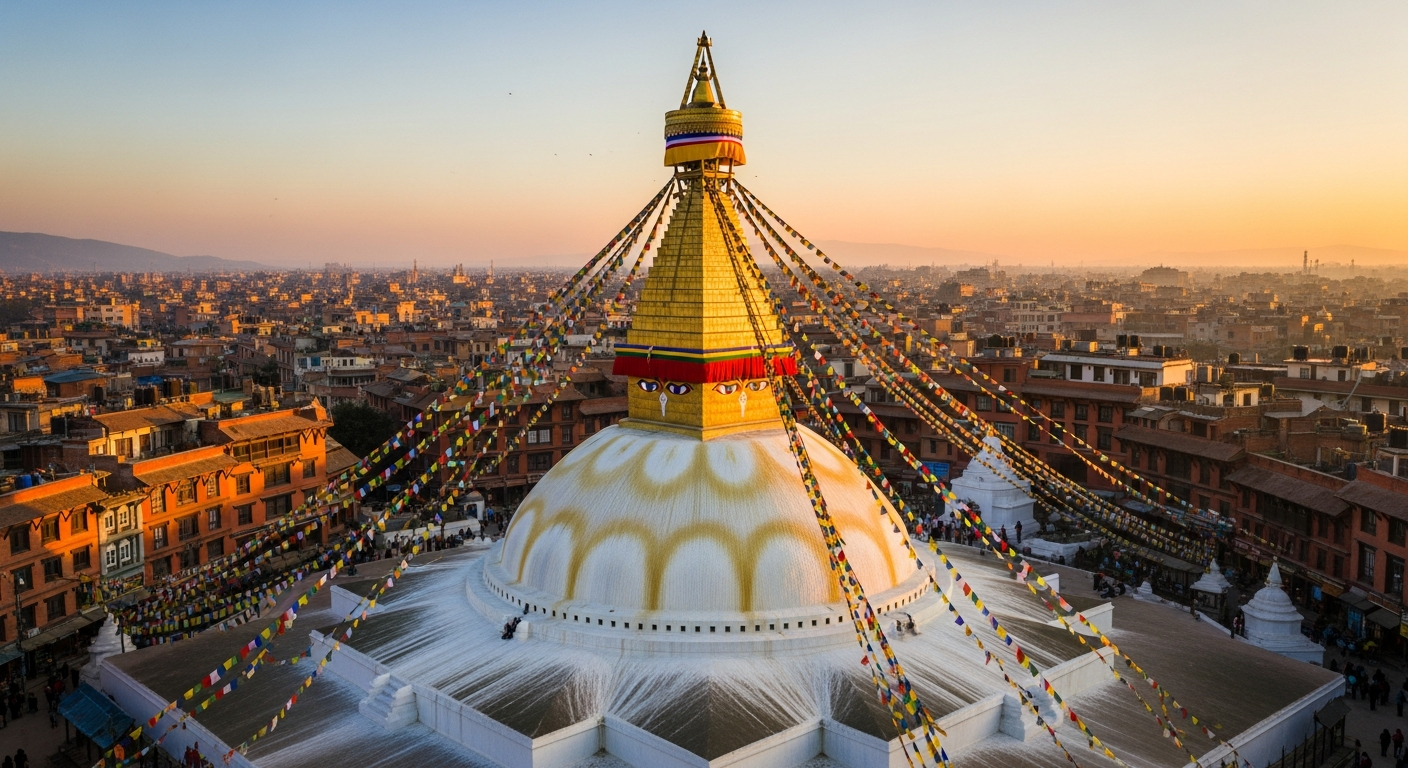
Boudhanath Stupa is one of the most magnificent and spiritually powerful places in Nepal — and indeed, one of the holiest Buddhist sites in the world. The stupa's massive white dome (diameter 120m) is one of the largest in Asia, and the towering golden spire with the all-seeing eyes of the Buddha creates an atmosphere of immense stillness and contemplation. The entire monument is a mandala — a three-dimensional representation of the universe — and circumambulating (walking around) the stupa clockwise while turning the prayer wheels is a standard act of devotion performed by thousands of Tibetan Buddhists, monks, nuns, and pilgrims every day.
The Boudhanath area is the heart of Tibetan Buddhism in Nepal — over 50 Tibetan Buddhist monasteries surround the stupa, and the area is the home of a large Tibetan refugee community. The atmosphere at dusk, when monks in saffron robes circumambulate the stupa while butter lamps are lit and chanting drifts from the monasteries, is unlike anything else in the world. For Indian pilgrims interested in Buddhism or simply seeking a deeply peaceful and spiritual experience, Boudhanath is unmissable.
Halesi Mahadev (Maratika Cave)
Halesi Mahadev — also known as Maratika Cave — is called the Pashupatinath of Eastern Nepal for good reason: this ancient cave temple complex dedicated to Lord Shiva is one of the most sacred and spiritually powerful sites in the country, yet remains far less visited by foreign tourists than the famous Kathmandu Valley temples. The main cave system contains naturally formed Shiva lingams and figures, and the atmosphere inside — with its echoing chambers, dim lighting, and incense — is deeply otherworldly.
Halesi holds deep significance in both Hindu and Vajrayana Buddhist traditions. Hindus worship it as a sacred Shiva shrine, while Tibetan Buddhists regard it as the cave where the great Guru Rinpoche (Padmasambhava) and his consort Mandarava attained immortality through meditation. The complex contains dozens of caves and shrines spread across a cliff face, with waterfalls and forest surroundings that heighten the sacred atmosphere. During Shivaratri and the main Halesi festival (Baisakh Shukla Purnima, April/May), thousands of pilgrims trek to the site.
Devghat Dham
Devghat Dham is one of the most revered tirthas (sacred pilgrimage sites) in Nepal — a place where the Trishuli River and Kali Gandaki River meet, creating a sacred confluence (triveni sangam) that is believed to be as purifying as the Prayagraj Sangam in India. Located on the Prithvi Highway between Kathmandu and Pokhara, Devghat is home to a large community of Hindu saints, ascetics, and renunciates (sadhus and sannyasis) who have come here to spend their final years in meditation and devotion.
The site contains dozens of temples including shrines to Vishnu, Shiva, Ram, and Radha-Krishna, and the atmosphere is one of quiet, ancient piety — far removed from the commercial bustle of the major tourist sites. Many devout Hindu families from Nepal and India bring the ashes of their deceased relatives to immerse in the sacred waters of Devghat. The most auspicious festival here is Makar Sankranti (January), when thousands of pilgrims take a holy dip at the confluence. Devghat is easy to combine with a visit to Chitwan National Park or as a stop on the Kathmandu–Pokhara journey.
Planning Tips for Indian Pilgrims
No Visa Required
Indian citizens don't need a visa for Nepal. Carry original Aadhaar, Voter ID, or Passport. Process at the Nepal immigration border takes 10–20 minutes.
Start from Gorakhpur
Gorakhpur is the closest major Indian city to Nepal's Sunauli border. From here, all Nepal pilgrim destinations are accessible within hours.
Temple Etiquette
Remove footwear before entering all temples. Dress modestly — cover legs and shoulders. No leather goods inside Pashupatinath. Photography rules vary; always ask first.
Altitude Caution
Muktinath (3,710m) and Gosaikunda (4,380m) require altitude acclimatisation. Don't rush up. Stay hydrated. Carry altitude sickness medication.
Best Festivals
Shivaratri for Pashupatinath (Feb/March); Vivah Panchami for Janakpur (Nov/Dec); Janai Purnima for Gosaikunda (Jul/Aug); Navratri for Manakamana.
Budget Planning
INR is accepted widely. Most temples are free for entry. Budget for transport, accommodation, and local food. Bhawani Travels packages are fully inclusive.
Suggested Combined Pilgrimage Routes
Route 1 — The Shiva Circuit (7 Days from Gorakhpur)
Gorakhpur → Sunauli → Lumbini (Day 1) → Bhairahawa → Pokhara (Day 2) → Pokhara → Jomsom → Muktinath (Day 3–4) → Pokhara → Manakamana (Day 5) → Kathmandu → Pashupatinath (Day 6) → Swayambhunath → Return (Day 7)
Route 2 — The Ram-Sita Devotee Route (6 Days from Gorakhpur)
Gorakhpur → Sunauli → Lumbini (Day 1) → Chitwan → Devghat (Day 2) → Pokhara → Manakamana (Day 3) → Kathmandu → Pashupatinath, Boudhanath (Day 4) → Kathmandu → Janakpur flight → Janakpur darshan (Day 5) → Return via Raxaul/Bihar border (Day 6)
Route 3 — Complete Nepal Yatra (10 Days from Gorakhpur)
Gorakhpur → Lumbini (Day 1) → Chitwan (Day 2) → Devghat → Pokhara (Day 3) → Pokhara sightseeing (Day 4) → Muktinath (Day 5–6) → Pokhara → Kathmandu (Day 7) → Pashupatinath, Swayambhunath, Boudhanath (Day 8) → Bhaktapur, Nagarkot (Day 9) → Janakpur → Return (Day 10)
Pro tip: The best overall time for a Nepal pilgrimage circuit is October–November — the weather is perfect, skies are crystal clear for mountain views, and the Dashain and Tihar festivals make every destination feel especially alive and devotional. For a Pashupatinath focus, target Maha Shivaratri in February/March — one of the most extraordinary religious events in all of South Asia.
Book Your Nepal Yatra with Bhawani Travels
We are based in Gorakhpur, just 90 km from the Nepal border — and Nepal pilgrimage tours are our speciality. All-inclusive packages: transport, hotels, meals, guide, temple visits. WhatsApp us now for a free, personalised pilgrimage itinerary.
💬 Plan My Yatra — WhatsApp Now